Footbinding and Women's Labor in Sichuan by Hill Gates
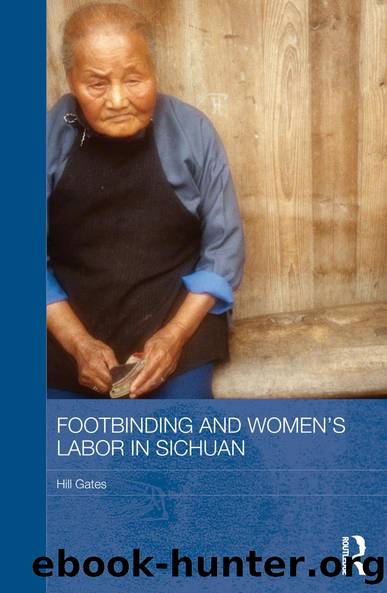
Author:Hill Gates [Gates, Hill]
Language: eng
Format: epub
Tags: Social Science, Women's Studies, Customs & Traditions, Anthropology, General
ISBN: 9781135042295
Google: jEK2BQAAQBAJ
Publisher: Routledge
Published: 2014-12-05T05:58:34+00:00
Notes
1 Unfortunately, we failed to ask if this was the result of post-1949 literacy campaigns, although I know that some cases were.
2 Buck argues at some length that tenancies were more profitable than owned land, despite the rent, because they were larger. To obtain this result, he includes in ownersâ costs the loss of interest that could have been âearnedâ had the land been sold and the money invested in the local money market. Buck presumably knew better to treat inherited land as a meaningless liquid asset, but the goal of this piece of research was to encourage âmodern methodsâ of farming; hence, the inappropriate, ur-capitalist logic.
3 Calculating whether girls married up or down depends on the structural positioning of their natal and marital families. The most direct analysis of hypergamy would compare the class position in the tributary/petty capitalist matrix of each womanâs natal and marital families as in Figure 4.3. Unfortunately, I lack information about the educational status of husbands and their parents; placing the informants after marriage in a matrix perfectly parallel to that of their natal families is not possible. Only evidence about marketable resources can be used.
4 These were collected with funding from the National Science Foundation (grants # BCS-0613297 and BCS-12389999) by Laurel Bossen, Melissa Brown, and Hill Gates and, for a site in Guizhou by Fan Chengdiao. The work of data management was insufficiently advanced when Brown et al. was written to include the complete data set that should, in future, supply yet better comparisons.
5 If this choice of parameters is faulty, the blame is mine.
6 Including 140 families who depended only on keeping a shop or workshop was considered, but rejected because their status relationships with land ownership, tenancy, and families that neither owned nor tenanted land are ambiguous. Omitting them simplified the comparison at the cost of a small amount of data.
7 These sites are in northern Anhui, northern Henan, Shaanxi, Hebei, and Shandong.
8 Ordinary spoken Chinese has an explicit comparison available, using emphasis rather than syntax.
First speaker: âThis watermelon is hao (good).â
Second speaker, âNo, this watermelon is haoâ (literally, âgood,â but in meaning, âbetter.â
Or the second speaker might put it, âNo, haishi this one is haoâââNo, this one is better.â
Native speakers understand âbijiao haoâââcomparatively good,â but it is rare except among native speakers of languages (like English) that have structurally necessary comparatives (like good, better, best). The implications of this usage are essential to understanding what women actually say about hypergamy.
Download
This site does not store any files on its server. We only index and link to content provided by other sites. Please contact the content providers to delete copyright contents if any and email us, we'll remove relevant links or contents immediately.
Spell It Out by David Crystal(36117)
Life for Me Ain't Been No Crystal Stair by Susan Sheehan(35811)
Cecilia; Or, Memoirs of an Heiress — Volume 1 by Fanny Burney(32558)
The Great Music City by Andrea Baker(32019)
Cecilia; Or, Memoirs of an Heiress — Volume 2 by Fanny Burney(31956)
Cecilia; Or, Memoirs of an Heiress — Volume 3 by Fanny Burney(31942)
Professional Troublemaker by Luvvie Ajayi Jones(29662)
The Secret History by Donna Tartt(19088)
We're Going to Need More Wine by Gabrielle Union(19046)
Twilight of the Idols With the Antichrist and Ecce Homo by Friedrich Nietzsche(18632)
All the Missing Girls by Megan Miranda(16028)
Cat's cradle by Kurt Vonnegut(15355)
Pimp by Iceberg Slim(14507)
For the Love of Europe by Rick Steves(14121)
Bombshells: Glamour Girls of a Lifetime by Sullivan Steve(14075)
Talking to Strangers by Malcolm Gladwell(13370)
Norse Mythology by Gaiman Neil(13365)
Fifty Shades Freed by E L James(13241)
The Social Justice Warrior Handbook by Lisa De Pasquale(12190)
